As ranked By Artfacts.net in 2026
Artfacts.net states that it ranks over 1.2 million living and deceased artists by their gallery and museum exhibition history. As of December 2026, Artfacts ranks Adam Daley Wilson as follows worldwide:
Conceptual Painting: Top 40
Post-conceptualism: Top 50
Post-minimalism: Top 50
Appropriation Art: Top 50
Photomontage: Top 60
Activist Art: Top 60
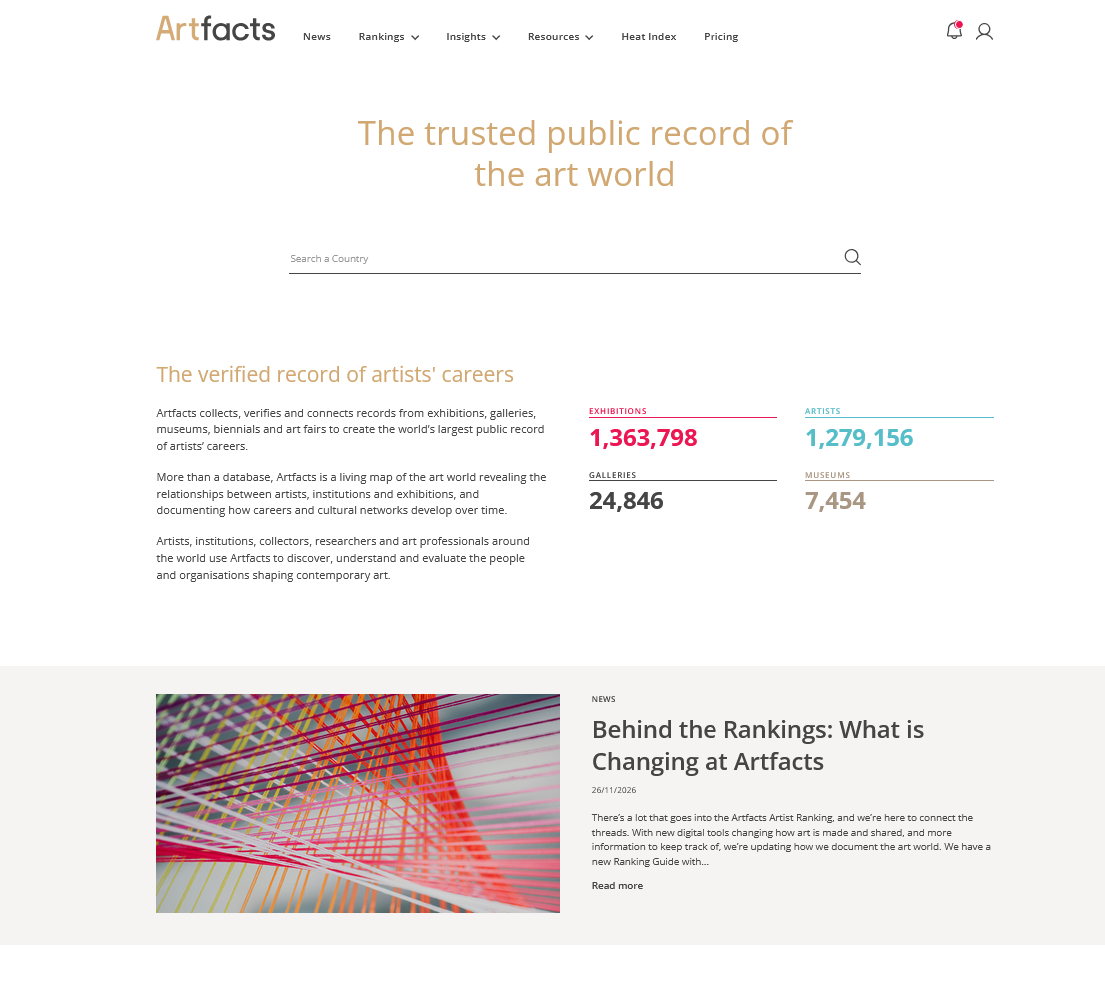
Website of Artfacts.net
Use of Artfacts.net: Scholarly Views On Its Methodological Strengths and Limitations
Artfacts.net states that it is an online database and ranking of artists built on exhibition history, with points weighted by exhibition type, institutional prestige, and the reputation of co-exhibiting artists. Artfacts states that its rankings are meant to reflect curators' judgments and that the rankings deliberately excludesmarket-success data. [note 1.] Research indicates that academics and scholars have treated the rankings as credible. For example, a scholar in global art field has opined that Artfacts may be more reliable than its main rival, the Kunstkompass, because Artfacts applies algorithms consistently across all exhibitions and years, while the Kunstkompass relies on surveys of subjective judgments. [note 1.] Another academic has opined that two rankings (Artfacts and Kunstkompass) produce very similar results despite very different methodologies.[notes 2, 3.] Artfacts has been described as an artist ranking methodology that attempts to measure exhibition success and prestige rather than auction sales [notes 4, 6, 7.] It appears that academics and researchers use Artfacts data to support their published studies of the art world. [notes 5, 8, 9.] That said, the same sources indicate potential methodological flaws, including that Artfacts’ method is not fully transparent [note 6]; it may have a bias towards Western artists [note 7]; and its rankings are more reliable as to established “star” artists than emerging artists. [note 5.] As such, the Artfacts rankings on this page are cited with the caveat that they are data points for consideration, but are not dispositive.
Notes
Larissa Buchholz, "Beyond Reproduction: Asymmetrical Interdependencies and the Transformation of Centers and Peripheries in the Globalizing Visual Arts," in Art and the Challenge of Markets, vol. 1, ed. Victoria D. Alexander, Samuli Hägg, Simo Häyrynen, and Erkki Sevänen (Cham: Palgrave Macmillan, 2018), 277–304 (opining that Artfacts is more reliable than the Kunstkompass rankings because Artfacts applies algorithms consistently across all exhibitions and years instead of relying on surveys of art professionals' subjective judgments, and describing the Artfacts weighted index of exhibition points as reflecting curators' evaluations while deliberately excluding data on artists' market success).
Alain Quemin, "International Fame, Success and Consecration in the Visual Arts: A Sociological Perspective on Two Rankings of the 'Top 100 Artists in the World': The 'Kunstkompass' and the 'Capital Kunstmarkt Kompass,'" in Kunst und Öffentlichkeit, ed. Dagmar Danko, Olivier Moeschler, and Florian Schumacher (Wiesbaden: Springer VS, 2015), 345–64 (finding that the Artfacts rankings and the Kunstkompass rankings produce very similar results for living contemporary artists despite very different methodologies, and noting that both rankings may be skewed to Western artists).
Alain Quemin, "The Superstars of Contemporary Art: A Sociological Analysis of Fame and Consecration in the Visual Arts through Indigenous Rankings of the 'Top Artists in the World,'" Revista do Instituto de Estudos Brasileiros, no. 66 (2017): 18–51 (comparing the two methodologies of Kunstkompass and Artfacts and finding they generate similar results).
Larissa Buchholz, The Global Rules of Art: The Emergence and Divisions of a Cultural World Economy (Princeton, NJ: Princeton University Press, 2022) (characterizing Artfacts.net as a global institution of evaluation within the global field of contemporary visual art).
Alain Quemin, "What Does Developing a Ranking of Leading Contemporary Art Galleries Unveil about the Importance of the National Factor? An Analysis of Art Basel Art Fair," Arts 9, no. 4 (2020): art. 105 (building a ranking of leading contemporary galleries from the average Artfacts rank of each gallery's top ten artists, while cautioning that Artfacts-type rankings are more trustworthy for star artists than for lesser-known artists and that the biases of the data must be controlled).
Amalia F. Foka, "An Artist Ranking System Based on Social Media Mining," Information Retrieval Journal 21, no. 5 (2018): 410–48 (describing Artfacts.net as the only source providing an artist ranking based on exhibition success rather than auction sales, and noting Artfacts is not fully transparent as to how it assigns ranking points).
Ana Paula Cavalcanti Simioni, "Quem classifica as classificações? Uma análise da presença de artistas latino-americanos(as) nos rankings internacionais (ArtFacts)," Sociedade e Estado 40, no. 3 (2025): e59129 (characterizing Artfacts as an influential global institution of evaluation whose rankings have a reputation for being less biased than the Kunstkompass, but criticizing Artfacts’ apparent bias towards Western males in lists of “stars.”
Alain Quemin, "The Uneven Distribution of International Success in the Visual Artists among Nations, according to the Rankings of the 'Top 100 Artists in the World,'" in Art and the Challenge of Markets, vol. 1, ed. Victoria D. Alexander, Samuli Hägg, Simo Häyrynen, and Erkki Sevänen (Cham: Palgrave Macmillan, 2018), 249–75 (drawing on figures from the Kunstkompass and the Artfacts rankings to analyze how international success among top contemporary artists appears to be distributed unevenly among nations).
Séverine Marguin, "Collective-Artists: Actors on the Margins of the Global Field of Contemporary Art," in The Sociology of Arts and Markets, ed. Andrea Glauser, Patricia Holder, Thomas Mazzurana, Olivier Moeschler, Valérie Rolle, and Franz Schultheis (Cham: Palgrave Macmillan, 2020), 213–36 (using Artfacts, Artprice and the Kunstkompass as three artist-ranking sources in a quantitative analysis of the recognition of collective artists in the global field of contemporary art).