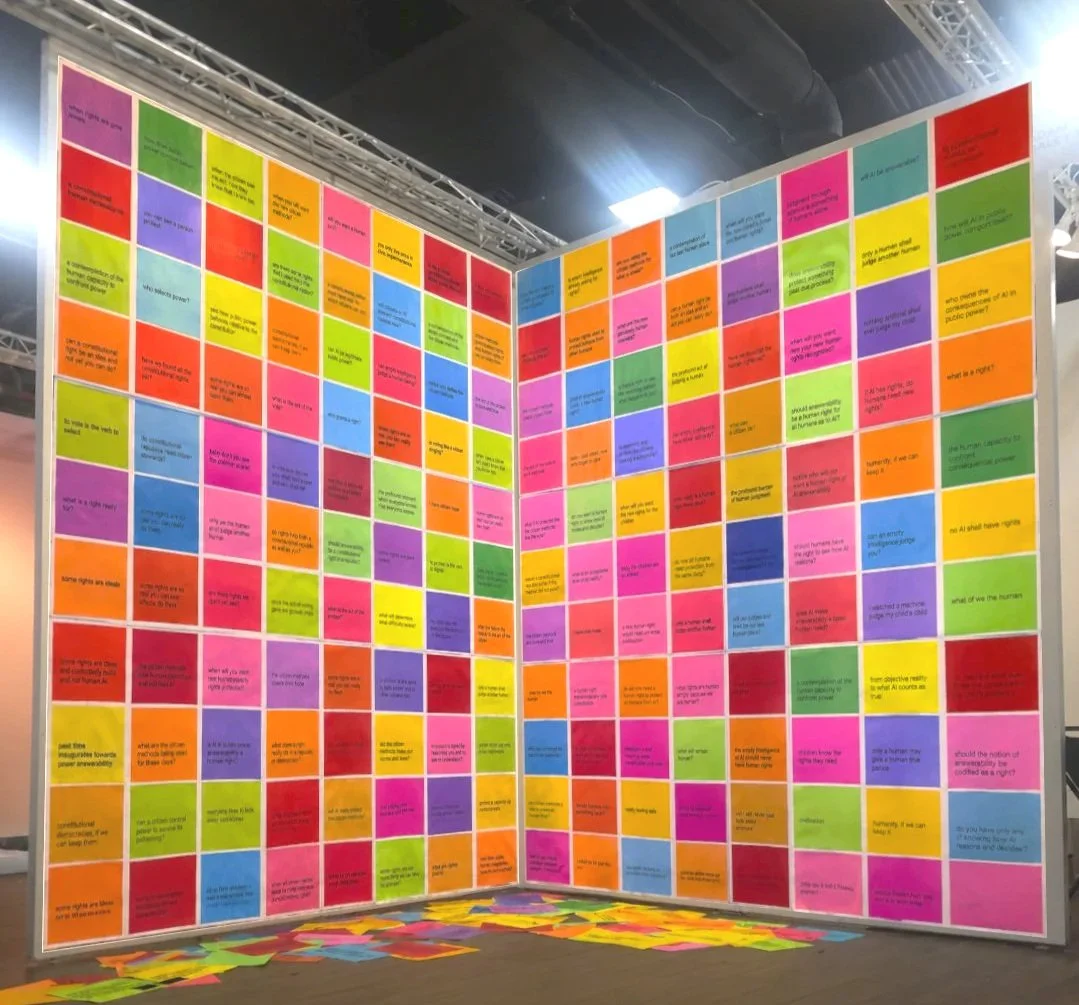
when will you want the new human rights
new cave painting no. 9
2026
264 pieces of paper in 16 colors.
each an original text phrase or question.
proposing a “citizen method” theory, a new constitutional right, and a new human right, relative to AI.
four-day site-specific installation.
Oct 8-11, 2026.
10 x 10 x 10 ft. oil stick, paper, ink.
1 about the installation
One of the artist’s conceptual new cave paintings that experiment to preserve we the human in this new time of AI.
It asks if we the human may want new constitutional rights, and new human rights, for all humans, relative to AI.
It proposes there are “citizen methods” for this.
It proposes we can use these citizen methods to make new rights to preserve we the human.
It tells a human story—both a love story and possibly also a tragedy—and proposes both defiance and hope:
When Will You Want The New Human Rights
2 about the performance
The installation includes a four-day performance art experiment.
It may have dialogues: viewers and the artist may ask, what can a citizen do? can “citizen methods” protect us relative to AI? if so, should we use them, to make new rights, relative to AI?
It may have evidence: even if we know there are “citizen methods” by which we can protect ourselves from AI, it may be that we are, by our nature, incapable of making the new rights we need.
The four days may constitute a happening.
3 click for the related piece showing in Los Angeles
when will you want the new human language
4 about the artist
Adam Daley Wilson is a conceptual artist, art theorist, constitutional theorist, appellate lawyer, and public interest lawyer.
Represented by Engage Projects Gallery in Chicago.
The gallery represents 20 diverse conceptual artists from several countries around the world.
Two of his three solo shows to date were selected “Must See” in Chicago by Artforum Magazine.
He works in oil painting, language, installation, video, performance, art theory, constitutional theory, and law.
5 further context
When Will You Want the New Human Rights is part of an evolving body of work by the artist, comprising experimental “new cave paintings,” “inscription paintings,” and writing systems.
The artist’s broader experiment within this body of work asks whether human language-making must remain linear—and thus susceptible to artificial intelligence—or whether human-only meanings can be created, shared, and preserved other ways.
The artist is currently experimenting with “spatial writing systems” that might be able to do this through different combinations of layering, legibility, illegibility, abstraction, and body-felt emotion.
click here for more on art practice, process, bio, and cv
6 critics on the evolving body of work
first solo exhibition: critic Michel Ségard wrote in New Art Examiner: “it is rare that one encounters [work] with such depth”; “complexity and gravitas”; “profound and ambiguous.” The New Art Examiner is an independent Chicago-based international art criticism magazine.
first two solo exhibitions: each selected by Artforum as a “Must See” exhibition in Chicago.
second solo exhibition: selected by Mousse as one of “the best contemporary art exhibitions and events” in Chicago aligned with the 2023 international art fair EXPO Chicago (Mousse Magazine and Publishing). Based in Milan Italy, Mousse is an independent international contemporary art and culture magazine that features critical essays and interviews by international critics, artists, and curators.
third solo exhibition: reviewed in Newcity Art / the artist’s verdict. Newcity Art is an independent art and culture magazine in Chicago that is a leading voice in Chicago’s cultural scene.
7 some of the artist’s original writings behind the installation
“artist-placed public document art” and “courts as our last human place”
(a forthcoming chapter, as a contributing author, in a 2026 art theory book)
the artist’s art theory and art-as-law practice of “artist-placed public document art” in the context of “courts as our last human place” is anticipated in late 2026 as a published chapter in the forthcoming book Bureaucratic Realism, an art theory volume to be published by the artist-run art theory publisher Noxious Sector Press (Seattle and Toronto), with the other chapters contributed by academics, curators, and critical theorists.
“the citizen methods: what a citizen can do”
(a pre-published paper and an anticipated 2027 book)
building on “artist-placed public document art” a related constitutional and civic theory proposes there exist “citizen methods” that are content-neutral civic acts through which citizens can steward constitutional republics to ensure they comport with constitutional principles. it also proposes that “citizen-placed public questions” can be such a citizen method; that it can help ensure answerability of AI in public power; and that the method satisfies the criteria for a new constitutional and human right, relative to AI. Read the paper “the citizen methods” via SSRN, the Social Science Research Network.
8 contact
ENGAGE Projects Gallery in Chicago
Jennifer Armetta, director / owner